

Tuesday, April 28, 2015
Appendix A
Language Change, Bible Translations,
and the Common Man

The OT was originally written in the language of the people of that time, Hebrew and Aramaic. Septuagint- translation of the Old Testament from Hebrew into Greek, the language of the common people of the day. The New Testament was originally written in Koine' Greek, the universal language of the Roman Empire at that time. As the gospel spread through out the world the New Testament was translated into other languages
---Coptic - common language of Egypt
---Syriac -
As the Greek language diminished and Latin gained prominence the New Testament was translated into Latin. First into OL and in mid 4th century AD Jerome, Latin Vulgate. (Vulgate is from L vulgaris, mob, common man)
As English gained prominance, the Word of God was translated into the English language. Wycliffe made first c 1384 from the Latin Vulgate, Tyndale made the first from original languages, 1526-30 As can be seen God's word has been in English a very short time, in comparison to other languages.
It can be observed that due to language change other translations are required periodically, in order to keep God's word in the tongue of common people.
Developed by L. G. Butler, 4503 53rd Street, Lubbock, TX 79414 December. 1990
Appendix B
Lindisfarne Gospels, C. 950
From The Lindisfarne and Rushworth Gospels.
Surtees Society, London, 1864. See p. 3.
fad'er gehalgad sie noma o'in tocyma'o
Pater s'cificetur nornen tuum, adveniat
ric o'in
regnum tuum,
hlaf userne daeguhaemlice sel us eghuelc
panem nostrum cotidianum da nobis
daege
cotidie,
j f gef us synna usra gif faestlice aec
et dimitte nobis peccata nostra siquidem
Pe f efns eghuelc scyldge us
et ipsi dimittimus omni debenti nobis,
j ne usic onkedZiu in costunge
et ne nos juducas in temtationem
Wycliffite Bible, C. 1384
The earliest version, reprinted from the text edited by Forshall and Madden, Oxford, 1850.
Fadir, halewid be thi name. Thi kyngdom come to.
3yue to vs to day oure eche dayes breed.
And fore'yue to vs oure synnes, as and we fore'yuen
to ech owynge to vs. And leèd not vs in to temptacioun.
Tyndale New Testament, 1525
Reprinted from a facsimile of the Bristol copy, see p. 7.
Oure father which arte in hevë, halowed be thy name. Lett thy kyngdO come. Thy will be fulfillet, even in erth as it is in heven. Oure dayly breed geve us this daye. And forgeve vs oure synnes: For even we forgeve every man that tras paseth vs; and ledde vs not into temptaciö, Butt deliver vs from evyll Amen.
Coverdale Bible, 1535
O oure father which art in heauen, halowed be thy Name.
Thy kyngdome come. Thy wil be fulfilled upon earth, as it is in heauen.
Geue vs this daye oure daylie bred. And forgeue vs oure synnes, for we also
forgeue all them that are detters unto vs. And lede vs not in to temptacion,
but delyuer vs from euell.
Great Bible, 1539
o oure father which art i heauen, halowed be thy name. Thy kyngdome come. Thy will be fulfylled, cue in erth also as it is in heauë. Oure dayly breed geue vs thys daye. And forgeue vs our synnes: For cue we forgeue euery man that treas paseth vs. And Leade vs not Ito temp. tacyon. But delyuer vs from euyll.
Geneva Bible, 1560
2 Our Father, w° art in heaue', halowed be thy Name:
Thy kingdome come: Let thy wil be done eue' in earth, as it is in heauen:
3 Our daily bread giue vs for the day:
And forgiue vs our sinnes: for euen we forgiue
euerie man that is indetted to vs: And lead vs not into temptation: but deliuer vs from euil.
Bishops' Bible, 1568
2 0 our father which art in heauen,
halowed be thy name, thy kyngdome come,
thy wyll be fulfylled, euen in earth also,
as it is in heauen.
3 Our dayly breade geue vs this day.
4 And forgeue vs our synnes:
For euen we forgeue euery man that trespasseth vs.
And leade vs not into temptation, but delyuer vs from euyil.
Reproduced by permission
American Bible Society
Appendix G
1. Is It A Safe, Sound, Reliable Source For Helping Me Learn What Was God's Original Message?
-
Is it a translation, or a paraphrase or condensed version? A translation is the most reliable.
b. If a translation, is it literal, idiomatic or a free rendering? Idiomatic [using expressions that are natural to the native speaker - pdc] is best, major problems can occur with the others. A literal translation sounds the best, until one considers the problems that could occur if a translator used the same word in another language to translate "kicked" in each of the following: "Joe kicked he ball," "Joe kicked the habit." and "Joe kicked the bucket." The translator must understand the meaning in the original language; then, "carry it across" into the other language, wording it in such a way that the original meaning—not just the word—remains the same.
c. Is the version by more than one translator? Generally, a single translator has a higher potential for error than does a group; "in the multitude of counselors there is safety" (Prov. 11:19). However, one competent, unbiased scholar is probably far better than a host .of incompetent or biased persons.
d. Are the translators competent scholars? To carry meaning across, the literal meaning of "translate", the translator must have mastery of both the original language/culture and the language/culture of the language translating into.
e. Is the translation from the original language, not a trans1aion of a translation? In the case of the Bible: Hebrew, Aramaic an Greek.
f. Are manuscripts of the text in the original language the most reliable? A major controversy arises on this point. Which one?it should be used: the Received Text, the Westcott and Hort, the Nestle's or the United Bible Societies' Greek text or another? This is no simple issue.
g. Did the translators take into account the latest and most reliable archaeological, historical, cultural and linguistic information currently available? It is important to keep in mind that he KJV scholars did not have available the vast amount of information such as the Dead Sea Scrolls obtained during the last 379 y4rs._-but this is no fault of theirs. They needed the translation then; they felt they must not wait. But now we do have much more information.
h. Does the translation have good reviews among people whose judgment you value?
i. Do the reviewers avoid bias, to the extent humanly possible? Evidence, of possible bias is the use of "name calling," "emotional appeal," "card stacking," "bandwagon," etcetera. Hav6 they examined both the strengths and weakness, or is it a one sided review? The use of such propaganda techniques, does not mean that the points are not valid nor worth considering, but they often do sBiblel bias, indicating that there may be more that should be considered, which hadn't been noted.
j. Do the reviewers provide good documentation and sound, reasoning to support their ideas? Or, do they make bold unsupported or weakly supported assertions? Or worse yet ask or imply that the readers should trust them, providing no documentation.
k. What are the reviewers' credentials? Is good scholarship indicated? Are they really knowledgeable about what they write o say?
l. Does the version have a good preface which provides the reader with information needed to make an informed decision about the translation/version? For example, from which language and text was it translated; how did they deal with meanings ti at are not always clear in the originals; who sponsored the work; ho did the translation?
2. Is It Readable, "Easy To Be Understood"? 1 Cor 14:92
-
a. Will common people be able to read it, thus really has access to God's Word? Keep in mind that an estimated 25 million functionally illiterate adults in the United States alone would have considerable difficulty even with the most easily read version. For many trying to read the KJV is a formidable, if not impossible task. As the translators argued in the preface to the original KJV ible, "But how shall men meditate in that, which they cannot understand? … Indeed without translation into the vulgar tongue, the unlearned are but like children at Jacobs well (which was deep without a bucket, or something to draw with: or as that person mentioned by Esay, to whom when a sealed book was delivered, with this motion. Read this, I pray thee, he was fain to make this answer, I cannot, for it is sealed."3
b. Will common people be able to safely reconstruct God 's original message? The need for frequent or lengthy explainations by a preacher may signal problems in this area. This depends on the preacher and is what led to the rise of the papacy and ultimately to the Dark Ages. Tyndale gave his life to help break this strangle hold on common people's access to the Word. His life's goal was to translate the Word of God into language that even the plough boy could know as well as or better than the cleric. Ultimately, he, as history records, was martyred for his commitment to this principle. Nonetheless, he succeeded in making the first English translation of the NT from the original language before his death. We must ever be on guard that, if at all possible, history does not repeat itself in this area.
c. Does it have few instances of words in common use today whose meanings have changed since it was translated?; hence the reader may think he/she understands, but hasn't correctly reconstructed God message? For example, in the KJV: peculiar, mean, nephews, man (mankind) have different meanings now than 379 years ago.
d. Will all readers find it sufficiently readable that they will spend time in the word? Even among good readers, if the task is overly challenging, it will become frustrating or at least so tiring that they will not spend as much time; or if they do spend the time, they will not be able to accomplish as much as they otherwise would.
e. Will the version, when read by the preacher from the pulpit, be readily understood by the congregation? Can more of the sermon time be devoted to the sermon content/message rather than having to define or redefine words, and explain awkward sentences structures?
3. Can People Of Different Language Variations Use It?
-
a. Does the translation take into account the major language variations among English speaking people? The meanings of words, figures of speech, syntax, and usage varies greatly from one region in United States to another, e.g. Boston, Atlanta, Milwaukee, Brooklyn, New Orleans, Palo Alto or Mud Lick, KY; it varies ethnical1y; e.g., German, Black, Hispanic, British or Native American heritage.
b. Does it take into account language variation by age? Often the younger generation "speaks another language" than the “older generation's"? In short, English is a melting pot of language varieties which variation must be considered in selecting a versior for general use.
4. Does The Style And Tone Inspire The Reader And Reverence God?
a. One of the hallmarks of the KJV is the majesty of its language. As Kubo and Specht have said, "Although it is desirable that a version have a simple, direct form of English, the language must be dignified and reverent. Slang, colloquialisms, and momentarily popular expressions should be avoided. It should be a worthy vehicle for the expression of the profound truths of the Word of God. A the same time, the version must have a literary appeal. It must be readable, euphonious, and interesting. It must be clothed in Ian-guage that will grip the heart. Only then can i speak with full force the words of truth the world needs to hear."
5. Do the marginal notes inspire confidence?
a. Notes, such as, "The best manuscripts omit.. ." have potential of shaking a weak person's confidence in the accuracy of the version, and worse yet in God's Word.
6. Does the particular version fit the particular purpose(s)?
-
a. Is it to be used for sustained reading for inspiration or to grasp the
structural overview of a book, or for careful reading, or depth study of a particular topic? verse?
b. Is it to be used for public reading in worship? Or for private rading and study?
c. Is the selection being made for ones own private use or to recommend for use by others? What might work well for one person as far are language is concerned may not be appropriate for others. For example, many people in the church are fluent intwo dialects, KJV and modern. However, many people with limted or no religious background likely will have far more difficulty than people who have basically learned 1611 English as a scond language variety from the KJV; hence what may be easy for one person may be very difficult for another.
7. Other?
a. Do we need to be limited to one translation? It appears safer to consult more than one. It is strongly recommended that ihe Preface to the 1611 KJV "The Translators to the Reader" be carefully read on this point. Unfortunately, the original preface is deleted in most KJV Bibles today. b. For many people, as Lewis has said, the major problem is not that they read a different translation, but that they read no translation!
2. "So likewise ye, except ye utter by the tongue words easy be under-stood, how shall it be known what is spoken? for ye sh speak into the air" (1 Cor. 14:9).
3. Preface to the original KJY Bible, "The Translators to the reader,” reprinted in Opfell, Olga S. The King James Bible Translators, Jefferson NC: McFarland & Company. 1982. p. 148.
4. Kubo, Sakae and Walter Specht. So Many Versions? Twentieth English Versions of the Bible, Grand Rapids, Ml: Zondervan tion, 1975, p. 207.
Appendix F
Translations/Versions
1384 Wycliffe (from Latin Vulgate) (c1384)
1535 Coverdale's Bible
1526 Tyndale's NT (1526) & Pentateuch (1530)
1537 Matthew's Bible
1539 Taverner's Bible
1539 The Great Bible
1557 Whitteñham New Testament
1560 The Geneva Bible
1568 The Bishop'sBible
1582 The Rheims New Testament; English College at Rheims
1609 The Douai Old Testament (1609-1610)
1611 King James Version (KJV), also called Authorized Version
1749 Challoner's Revision (1749-1750
1772 Douai Revision
1796 Four Gospels by George Campbell
1818 New Testament Translation by George Campbell, Doddridge and (James?) Macknight. 1826 Campbell. The Sacred Writing of the Apostles and Evangelists of
Jesus Christ, Commonly Styled The New Testament. Modification of an earlier translation by George Campbell, Doddridge and Mack night. Improvements by Alexander Campbell.
1862 Young's Translation. Literal Translation of the Bible by Robert Young, author of Young's Concordance.
1867 Smith's Holy Scriptures by Joseph Smith (Morman) It is now popularly referred to as Inspired Version.
1869 Afford's New Testament
1876 Smith's Bible by Julia E. Smith Parker. literal translation
1881 The English Revised Version (OT, 1885)
1900 Hayman's Epistles
1901 American Standard Version
1901 Modern American Bible
1901 Moffatt's Historical New Testament
1901 Way's Letters. The Letters of St. Paul to Seven Churches and Three Friends (WL). By Arthur S. Way. Revised to include Hebrews, 1906.
1901 Young People's Bible
1902 Emphasized Bible by Joseph Bryant Rotherham.
1902 Godbey's New Testament (date uncertain)
1902 Twentieth Century New Testament (WH text)
1903 Fenton's Bible in Modern English
1903 Weymouth Modern Speech New Testament
1904 Worrell's New Testament
1905 Lloyd's New Testment
1906 Forster—St. John, Epistles and Revelation by Henry Langstaff Forster.
1907 Bourne's Gospels by A. E. Bourne
1907 Moulton's Modern Reader's Bible by Richard G. Moulton
1908 Rutherford's Epistles by W. G. Rutherford
1909 The Bible in Modern English
1909 Weaver New Testament by S. Townsend Weaver
1910 Cunard's revision of St. Matthew's Gospel
1912 Improved Bible Union Version by American Baptist Publication Society
1913 Moffatt Bible
1914 Cunuington's New Testament by E. E. Cunnington
1914 Numeric New Testament "From Greek text as established by Bible Numerics" Edited by Ivan Parnn
1916 McFadyen—Psalms in Modern Speech and Rhythmical Form by John Edgar McFadyen
1917 Jewish Publication Society Bible
1918 Anderson New Testament from Sinai'tica Manuscript by H. T. Andersàn
1919 The Messages of the Bible. Edited by Frank K. Sanders and Charles F. Kent. Free rendering in paraphrase.
1921 Pym: Mark's Account of Jesus in Common Speech by T. W. Pym
1921 Shorter Bible by Charles Foster Kent, et al; omits about 66% of OT and 33% of NT.
1922 Plainer Bible for Plain People in Plain American by Chaplain Frank Schell Ballentine.
1923 The Riverside New Testament by William G. Ballantine
1923 Robertson's Translation of Luke's Gospel by A. T. Robertson
1923 Smith-Goodspeed Bible
1924 Centenary New Testament
1924 Labor Determinative Version by Determinative Revision Committee. "revised for the recovery of Biblical labor standards."
1924 Montgomery's Centenary New Testament by Helen Barret Montgomery
1925 Askwith's Psalms (Book IV and V) by E. H. Askwith
1925 Children's Bible. Selections from OT &. NT translated and arranged by Henry A. Gherman and Charles Foster Kent.
1925 People's New Covenant by Arthur E. Overbury. Based on Mary Baker Eddy premises.
1926 Moffatt's Translation of the Bible by James Moffatt. (revised in 1935)
1927 Kent's Student's Old Testament. Logically and chronologically arranged and translated by Charles Foster Kent.
1927 Smith-Goodspeed. OT by J. M...Powis Smith (1927) and NT (1923) Edgar J. Goodspeed Revised 1935. Reprinted with Apocrypha
1928 Christian's Bible—New Testament by George Le Fevre
1928 Czarnomska Version edited by Elizabeth Czarnomska
1928 Spiritualist's Matthew by J. W. Potter
1929 Gowen's Psalms by Herbert H. Gown
1930 Loux' Mark by DuBois H. Loux
1931 Wale's Psalms by Frank H. Wales
1932 Chaplain Ballentine translation and rearrangement to read as a modem novel, by Chaplain rank Schell] Ballentine.
1932 Kleist's Memoirs of St. Peter (Gospel of Mark) by James A. Kleist.
1933 Torrey's Four Gospels by Charles Cutler Torrey, "to show that Gospels of Matthew, Mark, and John were composed in Aramaic."
1934 Old Testament in Colloquial English. "Listed in E. H. Robertson's The New Translation of the Bible."
1934 Royds' Epistles and Gospels by Thomas Fletcher Royds
1934 Wade. The Documents of the New Testament by G. W. Wade. From WH text.
1935 Westminster Version of the Sacred Scriptures by English Roman Catholic scholars under the editorship of Cuthbert Lattey, S. J. Not an "official" translation.
1937 Cornish's St. Paul from the Trenches. Of 1 & 2 Corinthians and part of Ephesians by Gerald Warre Cornish.
1937 Greber's New Testament by Johannes Greber. "based mainly on Codex Bezae..."
1937 Martin's New Testament by William Wallace Martin.(Other parts of the bible between 1928-1941) "reconstructed 36 epistles into 21".
1937 Spencer's New Testament by Francis Aloysius Spencer, o. P. edited by Charles J. Callan, 0. P. and John A. McHugh, 0. P.
1937 Williams' New Test
ament by Charles B. Williams' in "language of the people" from WH text.
1938 Book of Books. New Testament by the United Society for Christian Literature to celebrate the centenary of the Annotated Paragraph Bible.
1938 Buttenweiser's Psalms by Moses Buttenweiser. Chronologically treated.
1938 Clementson's New Testament by Edgar Lewis Ciementson, The Evangelization Society of the Pittsburgh Bible Institute.
1939 Oesterley Psalms. by W. 0. E. Oesterley
1940 Dakes' Gospels by John A. Dakes, a Greek businessman
1940 St. Mark in Current English by Mary L. Matheson.
1941 Confraternity New Testament
1941 Challoner-Rheims Version (Revision)
1942 Emphatic Diaglott by Benjamin Wilson,
1944 Callan's Psalms by Charles J. Callan 1944 Wand's New Testament Letters, a paraphrase by J. W. C. Wand; Australia.
1944 Knox Bible (1944-1949)
1945 Stringfellow's New Testament by Ervin Edward Stringfellow. From WH text.
1946 Lenski by R. C. H. Lenski
1947 Eerdmans' Psalms by B. D. Eerdmans
1948 Letchworth New Testament by T. F. Ford
1949 Basic Bible by C. K. Ogden
1949 New Testament of Basic English
1949 Leslie's Psalms by Elmer A. Leslie 1951 Authentic Version by anonymous translator
1951 Vernon 's Mark by Edward Vernon
1950 New World Translation of the Christian Scriptures (revised 1951 & 1961) Jehovah's Witness
1952 New Testament in Plain English by Charles Kingsley Williams'
1952 Penguin Bible (Rieu) by E.V. Rieu
1952 Revised Standard Version (NT in 1946)
1954 Kissane's Psalms by Monsignor Edward J. Kissane
1954 Kleist and Lilly's New Testament by James A. Kleist and Joseph L. Lilly
1954 Kleist and Lynam's Psalms by James A. Kleist and Thomas Janes Lynam
1954 Moore's New Testament, by George Albert Moore
1955 Fides Translation (Psalms) by Mary Perkins Ryan
1955 Knox by Monsignor Knox
1955 Schonfield's Authentic New Testament by Hugh J. Schonfield
1956 Laubach's Inspired Letters by Frank C. Laubach
1957 Concordant Version
1957 Lamsa's by George M. Lamsa, translated from the Peshitta, an ancient Eastern MS (Original Aramaic).
1957 Phillips New Testament
1958 Hudson by James T Hudson
1958 The Amplified Bible by Frances Siewert(Paraphrase)
1958 Phillips' Modern English New Testament by J B Phillips
1958 Tomanek's New Testament by James L Tomanek
1959 Cressman by Annie Cressman
1959 Modern Language Bible (Berkeley) by Gerrit Verkuyl
1960 The Children's "King James" by Jay Green and "Peter" Palmer
1961 New World Translation—Jehovah's Witnesses by the New World Bible Translation Committee. Revised, edition.
1961 Noli's Greek Orthodox New Testament by Fan S Noli
1961 One Way: The Jesus People New Testament (same Norlie's NT 1951)
1961 Simplified New Testament (Norlie) by Olaf M. Norlie
1961 The New English New Testament (bible in 1970)
1961 Wuest's Expanded New Testament by Kenneth S. Wuest
1962 Children's Version, simplification and modernization of the KJV, Preface by Jay Green
1962 Revised Standard Version (New edition)
1962 Jewish Publication Society Old Testament (1982)
1963 Bech's New Testament by William F. Beck
1963 Gelineau's Psalms by Joseph Gelineau
1963 New American Standard Bible
1963 The Holy Name Bible by A. B. Traina
1964 Anchor Bible by William F. Albright and David N. Freedman
1964 Hadas' Psalms by Gershon Hadas
1964 Revised Standard Version (Catholic edition)
1965 Amplified Bible by Frances E. Siewert
1965 Bruce's Expanded Paraphrase by Drs. Scrivener, Moulton & Greenup, F. F. Bruce
1966 Burke's God is For Real Man. by Carl F. Burke. A free treatment of text.
1966 Good News for Modern Man Bible (1971)
1966 Jerusalem Bible by Alexander Jones
1966 Living Scriptures by Jay Green
l966 The Bible in Simplified English
1966 Today's English Version
1967 Dale's New World by Alan T. Dale
1967 Liverpool Vernacular Gospels by Dick Williams and Frank Shaw
1967 The Living Bible (Paraphrase) by Ken Taylor
1967 Greatest is Love Paraphrase (Paraphrase) by Ken Taylor
1968 Cotton Patch Version by Clarence Jordan
1968 Hanson's Psalms in Modem Speech by Richard S. Hanson
1968 Restoration of Original Name New Testament
1969 Barclay's New Testament by William Barclay
1969 Children's New Testament by Gleason H. Ledyard
1970 New American Bible by members of the Catholic Biblical Association of America (Confraternity New Testament)
1970 The New English Bible (NT in 1961)
1970 The Mercier New Testament by Kevin Condon
1971 Blackwelder's Exegetical Translation by Boyce W. Blackwelder
1971 New American Standard Bible
1972 The Bible in Living English by Steven T. Byington
1973 Common Bible (appears to be another name for RSV)
1973 New International Version
1973 The Better Version of the New Testament by Chester Estes
1973 The Translator's New Testament by team of 37 under the direction of W. D. McHardy.
1979 New King James Bible
1982 Reader's Digest Bible Bruce M. Metzger, general editor (condensed)
1986 Marshall Parallel New Testament. An interlinear by Alfred Marshall.
1987 New Century Version by the World Bible Translation Center, Ft. Worth, Texas. 1987 Easy-To-Read Version (1978, 1981, 1982) by the World Bible Translation Center, Ft. Worth, Texas. Based on the New Century Version. Also published under the name of English Version for the Deaf.
1987 The Everyday Bible by the World Bible Translation Center, Ft. Worth, Texas.Based on the New Century Version.
1988 International Children's Bible (1983, 1986). by the World Bible Translation Center, Ft. Worth, Texas. Based on the New Century Version.
1988 McCord's Translation of the New Testament by Hugo McCord
1989 New Revised Standard Version:
400 Jerome's Latin Vulgate
1528 Pagninus' Latin Bible
1556 Beza's Latin New Testament
Note: Boldface indicates complete New Testament or complete Bible; lightface type signifies a portion of the Bible.
Compiled by L. G. Butler. Information came primarily from Kübo, Sakae and Walter Specht. So Many Versions? Twentieth Century English Versions of the Bible. Grand Rapids, MI: Zondervan Corportion, 1975. Chart of the English Bible. New York: American Bible Society, 1990. Herbert, A. S. Historical Catalogue of Printed Editions of the English Bible 1525-1961. (Revised and Expanded from the Edition of T. H. Darlow and H. F. Moule, 1903), London/New York: The British and Foreign Bible Society/The American Bible Society, 1968. A Ready-Reference History of the English Bible (1971 Revision). New York: American Bible Society, 1971.. These, in addition to a limited personal collection. For most entries it was not possible to confirm accuracy in a primary source. This list is probably not comprehensive. Time and space limitations constrained the amount of information which could be included. For more detailed information see the references cited. This list should be viewed as a working draft rather than a final list. Please send any corrections, additions, or suggestions to
L. G. Butler, 4503 53rd St., Lubbock, TX 79414.
Appendix D
Due to 379 Years of Language Change
Obsolete Words in KJV
almug, algum, charashim, chapt, earing, gat, habergeon, hosen, ligure, leasing, maranatha, nard, neesing, pate, pilled, rabboni, raca, ring-straked, stacte, strake, sycamyne, trode, wimples, ouches, brigandine, ambassage, occurrent, purtenance, bruit, fray, cracknels, mufflers, anathema, corban, talitha cumi, ephrata, aceldama, centurion, quarternion, delectable, carriage, let, pityful (for full of pity), wot, trow, sod, and swaddling clothes.
Sentences from the KJV: "Easy to understand?"
Job 36:33 "The noise thereof sheweth concerning it, the cattle also concerning the vapour."
2 Cor. 8:1 "Moreover, brethren, we do you to wit of the grace of God bestowed on the churches of Macedonia."
1 Cor. 4:4 "For I know nothing by myself; yet am I not hereby justified: but he that judgeth me is the Lord."
2 Cor. 6:12 "Ye are not straitened in us, but ye are straitened in your own bowels."
2 Cor. 10:16 "To preach the gospel in the regions beyond you, and not to boast in another man's line of things made ready to our hand."
Eccl. 12:11 "The words of the wise are as goads, and as nails fastened by the masters of assemblies, which are given from one shepherd."
1 Cor. 8:7 "Howbeit there is not in every man that knowledge: for some with conscience of the idol unto this hour eat it as a thing offered unto an idol; and their conscience being weak is defiled."
Ex. 19:18 "And mount Sinai was altogether on a smoke, because the LORD descended upon it in fire: and the
Psa. 5:6 "Thou shalt destroy them that speak leasing: the LORD will abhor the bloody and deceitful man."
1 Kings 11:1 "But king Solomon loved many strange women, together with the daughter of Pharaoh, women of the Moabites, Ammonites, Edomites, Zidonians, and Hittites."
Job 36:33 "The noise thereof sheweth concerning it, the cattle also concerning the vapour.”
Isa. 31:1 "Woe to them that go down to Egypt for help; and stay on horses, and trust in chariots, because they are many; and in horsemen, because they are very strong; but they look not unto the Holy One of Israel, neither seek the LORD!" Ezek. 27:25 "The ships of Tarshish did sing of thee in thy market: and thou wast replenished, and made very glorious in the midst of the seas,"
Lk. 17:9 "Doth he thank that servant because he did the things that were commanded him? I trow not."
Jn. 15:2 "Every branch in me that beareth not fruit he taketh away: and every branch that beareth fruit, he purgeth it, that it may bring forth more fruit."
Eccl. 12:11 "The words of the wise are as goads, and as nails fastened by the masters of assemblies, which are given from one shepherd."
1 Cor. 8:7 "Howbeit there is not in every man that knowledge: for some with conscience of the idol unto this hour eat it as a thing offered unto an idol; and their conscience being weak is defiled."
Words Still In Use Today But With Different Meanings Than In 1611.
(Numerous other examples may be found in Lewis, pp. 55-58, 43-347)
Mean
Prov. 22:29 "Seest thou a man diligent in his business? he shall stand before kings; he shall not stand before mean men." (common men "that which is in the middle," Oxford English Dictionary)
Man / Men
Mt. 5:13 "Ye are the salt of the earth: but if the salt have lost his savour, wherewith shall it be salted? it is thenceforth good for nothing, but to be cast out, and to be trodden under foot of men." ("A human being, irrespective of sex or age; = L. homo in OE," Oxford English Dictionary)
Peculiar
1 Pet. 2:9 "But ye are a chosen generation, a royal priesthood, an holy nation, a peculiar people; that ye should shew forth the praises of him who hath called you out of darkness into his marvellous light." (that which belongs to one person)
Carriage
Acts 21:15 "And after those days we took up our carriages, and went up to Jerusalem." (that which is carried, Oxford English Dictionary)
Nephews
1 Tim. 5:4 "But if any widow have children or nephews, let them learn first to shew piety at home, and to requite their parents: for that is good and acceptable before God." (grandchildren, nephews or other descendants, Oxford English Dictionary, the meaning of the Greek word, Vine, p. 171.)
Suffer
1 Cor. 10:13 "There hath no temptation taken you but such as is common to man: but God is faithful, who will not suffer you to be tempted above that ye are able; but will with the temptation also make a way to escape, that ye may be able to bear it." (permit)
Meat
Lev. 14:10 "And on the eighth day he shall take two he lambs without blemish, and one ewe lamb of the first year withoutbiemish, and three tenth deals of fine flour for a meat offering, mingled with oil, and one log of oil." (meant food in 1611)
Corn
Jn. 12:24 "Verily, verily, I say unto you, Except a corn of wheat fall into the ground and die, it abideth alone: but if it die, it bringeth forth much fruit." (In 1611, corn meant "kernel or grain," clarifies the "corn of wheat")
Quit
I Cor. 16:13 "Watch ye, stand fast in the faith, quit you like then, be strong." (to do ones part, behave, bear oneself, usually in a specific way Oxford English Dictionary. Same meaning in Vines)
Spelling of Proper Names in KJV Different in NT from OT
Boaz—Ruth 4:13 -Booz—Luke 3:32 -Boos (in 1611 edition)
Elijah-2 Ki 1:3 -Elias—Matt 27:47
Isaiah—Isa 40:3 -Esaias-Mat 3:3
Jeremiah—Jer 31:15 -Jeremy—Mat 2:1 -Jeremias—Mat 16:14
Judah—Gen 35:23 -Judas—Mat 1:2
Judah—Mic 5:2 . Juda—Mat 2:6 -Judaea—Luke 2:4
Jonah—Jonah 1:17 -Jonas—Mat 12:40
Mahalaleel—Gen 5:12 -Maleleel—Luke 3:37
Methuselah—Gen 5:22 -Mathusala—Luke 3:37
Noah—Gen 5:30 -Noe—Luke 3:36 -Noah—Heb 11:7
Passover—Ex 12:11-48. Easter—Acts 12:4 (Young's)
Sarah—Gen 17:15 -Sara—Heb 11:1 -Sarah—Rom 9:9
Shem—Gen 5:32 -Sem—Luke 3:36
Uriah-2 Sam 11:3 -Urias—Mat 1:6
Zion—Isa 28:16 -Sion—Heb 12:22, 1 Peter 26
2. "So likewise ye, except ye utter by the tongue words easy to be understood, how shall it be known what is spoken? for ye shall speak into the air" (1 Cor. 14:9). It is important to keep in mind that this is not a criticism of the Word of God nor the KJV; instead
3. Lewis, op cu, pp 53-54
4. Burchfield, Robert W. The Compact Edition of the Oxford English Dictionary. Oxford University Press, 1971. The Oxford English Dictionary, First edition, together with the Supplements and the Second Edition (20 volumes) published in 1989, are outstanding sources of information regarding the meanings of English words during various periods. This is an excellent reference for checking meanings of words as they were commonly used in 1611, as well as other periods. It is expensive. May be found in many public or university libraries.
5. Vaughn, Curtis (general editor) The Bible from 26 Translations, Grand Rapids, MI: Baker Book House (for 1 Tim. 2:15), p. 2424. This appears to be an excellent tool for alerting the reader to possible language change which may cause readers to misunder-stand the KJV. It could then send the reader to other authoritative sources such as, Vine's Dictionary of New Testament Words or The Oxford English Dictionary among others for clarification or verification of meanings.
Translations: Should We Insist
on the King James Version Only?
on the King James Version Only?
1990 Preacher Study Notes
To "prove all things" is essential and noble. But for many people this may be a difficult, if not impossible task due to their limited reading ability. For years I, like others, have preached to audiences: "prove all things;" "search the scriptures to see whether those things are so." Some recent experiences have illustrated to me, however, that it is not safe to assume that all listeners have sufficient reading ability to do so.
Some examples will illustrate. A few years ago a mother in her mid thirties brought her daughter to the Reading Lab which I direct for help with reading. After I explained how I felt we could help her daughter, the mother looked at me with tears welling in her eyes and asked, "Do you think you can help me learn to read?" On another occasion a thirty-five year old man came and said "I can't read. Can you help me? I want to be able to read to my six year old daughter." We did, and I shall never forget the joy he expressed when he read his first simple children's book to her. Another time I was getting onto a middle aged, fellow Christian pretty good for not studying his Bible more. He hesitated, then in sort of a broken voice said, "L. G., I can't read very well." I had known him for five or six years, and never knew. We just cannot assume, even among Christians, that all can read well enough to "search the scriptures" and "prove" as needed.
Moreover these are not just isolated cases. Research indicates that approximately 25 million American adults are functionally illiterate; that is, they lack sufficient reading ability to meet the demands of current society.1 This represents about one out of every six Americans. We are talking about a major problem! But, while I am concerned about their ability to read, I am more concerned about their having access to the Word of God.
This concern, I learned from Brother Richard Bunner, was shared by the restoration preachers in the early 1800s. Many of them argued that new translations were needed so the common people of their day could be able to read God's Word with understanding. It is almost ironic that there are more than twice as many functionally illiterate adults in the United States today than the entire population of the United States in 1820 when the restoration preachers were making their plea on behalf of those who had limited reading ability.
But do these "common people" who cannot read or cannot read well want to read the Bible? The data indicate yes. In fact many people who sign for adult literacy programs indicate they do so in order to read the Bible.2
Readability and normative test data indicate that about 4-5% of college graduates (1 out of 20) and 9% (or 1 of 11) high school graduates would have difficulty reading the King James Version of the Bible with understanding. This is of major concern to me that millions of persons in the world cannot gain access to the word of God, "the bread of life."
Three options appear to be available. We can get easier to read material, easier to read translations. Or, we can help increase the reading level of people to match the difficulty level of the material through adult literacy programs to teach those to read. In fact, the primary reason that schools were founded in the colonial period of the United States was to teach the citizens to read so they could read the Bible.3 A third option is just to say "The King James Bible does not seem all that hard to me; this is no problem of mine." I am concerned that we cannot let it go at that.
We are at a pivotal point. Speakers in many congregations are changing translations whether we want to or not. I see many speakers using various translations: the Amplified, the New King James, the American Standard Version, the New International Version, and the Revised Standard. Bible sales also indicate a change. The New International Version is quite popular. Statistics from an evangelical group indicate that no other version of the bible has ever out sold the KJV. This fall, for the first time in the history of this country, the NIV is outselling the KJV this 1990 Christmas season. [Thiatwas over 25 years ago! Pdc] That tells us something. We cannot ignore this important topic.
I have difficulty dealing with this topic, however. Let me illustrate. There is an intellectual side of this topic and an emotional side. The intellectual side of me tells me that we need to change to a more readable version, and to do so quickly. The emotional side says, hold back. I find it not easy to change. When the back came off of the KJV Bible I have used for over thirty years, I elected to have it rebound. It is familiar. For me this is not an easy task.
Using more than one translation/version in the worship service can cause a lot of confusion and make it difficult for people to follow along in the reading and to "prove all things." Recently I read from another version during a chapter study. As I announced the chapter and started to read, I observed many persons in the audience reach for a pew Bible (which is KJV). Not long after starting to read from the other version, many people started to look confused, then closed their bibles, and leaned back. In a business meeting one of the brethren asked "I wonder if we are going to read from one of the other translations, should not we have copies of that translation for the audience to be able to follow along?" That is a compelling argument to me. This situation is not good. The big question is which version do you get? I do not have an answer to this one, yet. First, we have to decide whether we are going to change to another version; then, we must decide which version.
My thesis today is that we need to make a change from the KJV for a number of reasons to be noted later. I am perplexed, however, as to what to change to, even after an intensive study of this topic for the past several months.
This is a very sensitive topic. After the topic of this presentation was announced I have received phone calls arguing for staying with the KJV, with strong feelings being expressed. In fact, what I have to say may press a "red button" for some of you. By that I mean cause negative reactions. I just appeal to you to be open minded and examine the evidence. Then, "prove all things."
The primary reason we have the Bible in written form (like other written material) is because people have a tough time remembering things that are heard. We tend to get things confused; so we write them down. But once written there is a lot more permanence to the ideas.
In view of this fact a lot of prayer and thought have gone into preparing these materials. Like Tyndall put in the preface of his translation, “if you find anything that is not right, let me know.” This is also my plea. If I know my heart, and I think I do, there is nothing more that I want to do than to please God. In dealing with this topic I feel like I am treading on ground where angels fear to trod. I tell you; I have prayed much about this. I solicit your prayers as we examine a very, very important topic. What we are dealing with is how we define or identify our "north star"; where we get our bearings. What is really, valid, true? For when we "prove all things" we must have something that we can rely on, have confidence in it that it is true-on which we can anchor our souls.
Let us now examine the reasons some people insist on using only the King James Version, why we should consider some other version, and review the evidence in relationship to this crucially important topic. We are dealing with issues that affect peoples' souls. On the one hand it needs to be readable, but it also needs to be doctrinally sound. The thing that scares me right now is that I see other translations that are being used because they are more readable, but are not safe. I am afraid that some people are getting materials primarily because they are easier to read without adequate thought to their doctrinal soundness And in the final analysis many people are going to change to others no matter what we do. It concerns me, however, that we may select a bad version by default. And that is scary. Included in this study are some guidelines for selecting a translation/version.
on the KJV Only
Many people hold to it because of tradition. Not all traditions are bad. Tradition means something that has been handed down. Traditions can be either good or bad. Many people have used it all their life. Anything else sounds unfamiliar. The problem with this reason is that persons have not really examined the issue carefully to determine the soundness of the reasons Doing something just because that is what we have always done does not make it either right or wrong.
Some people hold to the KJV because they have responded to what we have preached, but have mistakenly applied it. We have taught: "Do not add to nor take from" the Word of God. A warning that is worth. hearing: "But though we, or an angel from heaven, preach any other gospel unto you than that which we have preached unto you, let him be accursed. As we . said before, so say I now again, if any man preach any other. gospel unto you than that ye have received, let him be accursed" (Galatians 1:8-9)4
So if any thing does not sound "right", does not ring true or does not sound like what I know in my Bible, or if it does not look like my Bible, that is, the version I am accustomed to using. I remind us that "wolves in sheep's clothing look mostly like sheep. It is only when we see what might look like a tail, a paw instead of a hoof, one is alerted that something may be amiss. So any time there is any variance in the wording it may be viewed as error, although it may be saying the same thing; just worded a little differently.
Others consider it to be the only "Authorized" version. Indeed the KJV is referred to as the "Authorized Version." This is printed in many Bibles. However, there appears to be no evidence that it was ever officially "authorized" by anybody.5 It appears that the printers put this on it because “it sells”. King James indeed commissioned the translation, but there is no evidence that this version is any more authorized than any other translation.
Other arguments for the KJV include that it has stood the test of time --- 379 years, and is still popular. We owe much of our spiritual heritage to the KJV. It has worked well in converting thousands, and indeed it has. This could also have been said of earlier translations/versions prior to the KJV (e.g. Latin Vulgate, Septuagint). Some people believe it to be from a better Greek text (The Received Text) than many of the more recent versions. This is an area that I believe we really need to study. Some of our brethren are doing some work in that area. My topic does not deal with textual criticism, and I am not prepared to pursue that issue today. But this is an important issue. For it appears sufficient now to note that all translations are not from the same Greek text. The American Bible Society Chart6 shows various translations from the Greek and Hebrew. It may appear from the chart that these may be from the same text but they are not.7 Indeed, many of the New Testament translations were from the Greek language, but they were from at least three or four Greek texts8. We have no original Greek manuscripts of the Bible, only copies.9
Some people feel that the KJV uses more reverent language (e.g., thee, thou in reference to God). There is no evidence that "thee" and "thou" were any more reverent in 1611 or in Bible times than other pronouns such as "he" or "you."
Some say, "Why Change? I do not have any trouble understanding it," This is to ignore some information we noted earlier about the difficulty the KJV presents to persons with low reading ability. Others are not changing because of expedience. Some feel we should change, but do not want to offend others. Others feel we should change, but have not found an acceptable alternative. I am at that point right now. I feel we should change, but I have not found a version that is acceptable, yet.
In the early church there were people endowed with a gift to be able to "interpret." We have talked a lot about tongues over the years, the ability to speak to people in their own language. We know very well on the day of Pentacost when the apostles stood up to speak, the people later asked, " And how hear we every man in our own tongue, wherein we were born?"11 This has been a theme throughout time. I am not unaware of the fact that Peter said of Paul: "As also in all his epistles, speaking in them of these things; in which are some12 things hard to be understood.”13 It is instructive to note however that it says "some" and not "all." The thesis is that generally words are easy to be understood. And in every case, if it be hard to be understood, there were put into the church individuals whose responsibility it was to interpret.14 It may be for dealing with hard words or foreign language. They were to translate the message so that everyone would be edified.15 Therefore, we have biblical reasons for making communications so that the people can understand—"easy to understand."
“But it is high time to leave them, and to shew in brief what we proposed to ourselves, and what course we held in this our perusall and survey of the Bible. Truely (good Christian Reader) we never thought from the beginning, that we should need to make a new Translation, nor yet to make of a bad one a good. . . but to make a good one better, or out of many good ones, one principail good one, not justly to be excepted against; that hath been our endeavour, that our mark. 16
They also stated "But how shall men meditate in that, which they cannot understand?"17 Further, “Translation it is that openeth the window, to let in the light; that breaketh the shell, that we may eat the kernel!; that putteth aside the curtain, that we may look into the most holy place; that removeth the cover of the well, that we may come by the water, even as Jacob rolled away the stone from the mouth of the well, by which means the flocks of Laban were watered. Indeed without translation into the vulgar18 tongue, the unlearned are but like children at Jacobs well (which was deep) without a bucket, or something to draw with: or as that person mentioned by Esay, to whom when a sealed book was delivered, with this motion. Read this, I pray thee, he was fain to make this answer, I cannot, for it is sealed.”19
This was printed in every copy of the original King James Bible. It has long since been removed from most copies of King James Version bible.
Through the years many people have seen the need for translating the Bible into the language of the common people of their day. Let us examine this from a historical perspective. See Appendix A for the Time Line: Language Change, Bible Translations, and the Common Man. Let us start from today and move backwards on the chart. It is important to keep in mind while examining this evidence that "the word of God endureth forever."20 Some people have problems thinking that if a translation is made that it is actually changing the word of God. In fact, some people have the mistaken notion that the apostles must have used the King James Version, not realizing that the KJV did not come into existence until nearly 1600 years after the apostles lived. On the chart note the center reference point of B.C./A.D.
Let us begin in 1990 and follow the bottom line for the KJV to note how little a distance back in history it goes. Note at the bottom of the table that the KJV only goes back to 1611. There are centuries prior to that during which no person, including the apostles could have had access to the KJV. There were English translations prior to 1611 as are noted on the chart going back to as early as A.D. 1380.21 1 In fact, prior to about A.D. 449—four hundred years after Christ lived—there was not even the English language much less a translation of the Bible into English. We are so culture bound!
It is important for us to view the use of English language in a proper perspective. Because English is so prominent today we may be seduced into thinking, mistakenly that it has always been so prominent. For example, English is spoken all over the world today. There are more copies of the Oxford English Dictionary sold in Japan than in the United States; and there are more people in China studying English than, the total population of the United States today. With the prominence that the English language occupies today it would be easy for us to think that this may have always been the case, but it is not. As one follows the chart, it may be noted that prior to A.D. 449 there was no English language, instead the language of the common people was primarily Latin. And prior to Latin, Greek was the language of the common people, dating back to the 1400s B.C. And prior to it Hebrew was the language of the common people.
Note on the time line going from left to right that God has spoken to His people from the very beginning using the language of the common people. He spoke to Abraham and others nearly 2000 years B.C. using their language, Hebrew. For shundreds of years Hebrew was their primary language until after the Babylonian captivity. When the Israelites, God's people, were dispersed throughout the world, the language of the common people was primarily Greek. The Greeks had gained primary control throughout the world; God was setting the stage for the coming of Christ. As may be noted, the Greek language had developed by around 1400 B.C. By around the third century BC the Jewish people were speaking Greek primarily.
This is the way language works; we learn the language of the people around whom we work. There developed a need for people to have a Bible in the language of the common people. The Septuagint translation of the Old Testament was made from Hebrew into Greek language. The primary reason for this translation was so that God's Word could be read by the common person. The Greek language was the universal language at the time of Christ, and that is what they preached in, and I understand that New Testament quotations of the Old Testament were in the Greek, although the original was in Hebrew. This provides evidence that the Word of God is not in any particular language or particular word.
The Word of God is ideas, His will. It does not matter the language. But it was brought over into Greek from Hebrew. As is illustrated on the time line, the Greek language lost its prominence with the rise of the Roman Empire. Latin became the primary language of use. By around A.D. 150 there was a need again to translate God's Word into other languages. They translated it into Coptic, which is an Egyptian language; they translated it into Old Latin. And by around A.D. 300 there was a great need for another translation because most people could not read the Greek Bibles. Jerome was commissioned to refine the Old Latin Bible, and the Latin Vulgate was developed. I had heard of the Latin Vulgate all of my life, but one day I thought “Vulgate" sounds an awful lot like "vulgar.” I wonder if they are related? Sure enough, they are both from the Latin word vuaris which means "of the mob, vulgar, & volgus mob, common people"2 Vulgar, used to mean common or of the masses, rather than "filthy" as it does today. Thus, Vulgate was a bible for the common people, or masses, hence the name "vulgate"
It is no longer the language of the common people of today, but it was at that time. It appears to be instructive to note that about 300 years after the Latin Vulgate was translated, peoples' language changed, and it got so that only the preachers and the clerics (who were generally well educated people) could read it, but not the common people The priests said "trust me, trust me." You know what happened in the A.D. 600s: the rise of the papacy, the first pope and the Roman Catholic Church. This appears to be educational. When the common people cannot get access to (i.e. read with under-standing) the Bible, they can be controlled by others. The church went into the dark ages. Alter a number of years, some preachers were beginning to argue that they needed to have the Word of God so the common people can understand it. Some preachers, the priests-mostly Catholic-were writing in the margins of the Latin Bibles the Anglo-Saxon translation.23 In effect they were making an interlinear.
To illustrate the degree of language change, see Appendix B for a reprint of how the Bible looked in A.D. 950. The bottom line is Latin and the top is the English translation.24 By 1384, the Wycliffite Bible (C) is somewhat easier to read, but still illustrates how much the English language has changed since then. By comparing it to the Lindisfarne Gospels, C. 950 one can see how much change can occur in approximately four hundred years. As may be seen in Tyndale's translation, it is getting easier still. Not onl did the visual printing change, but its sound (pronunciation) changed, too.25
I do not know whether English language will change as much in the future as it has changed in the past. The point is this: language is changing; we cannot modify this. Instead we must address it.
As may be seen on Appendix C (Time Line: Bible Translations, English Language and Church History), many translations came out at about the time of major historical movements. Note on the time line all of the events that occurred during the reformation period starting in the 1400s. Note in the right hand column of the time line the first printed book: Gutenberg Bible, England Breaks with Rome (1534), Tyndale's translation (1535), in 1534 Henry VIII, then the Great Bible (1539), incidentally the Geneva Bible was the one used by the Puritans in contrast to the Bishop's Bible. I understand the Pilgrims brought the Geneva Bible to Plymouth Colony, America in 1620.
on the KJV
Words:
The following are examples of words used in the KJV which are no longer in current use. Many people would likely have difficulty reading these with understanding. For example: “chapt, habergeon, stacte, wimples, ouches, ambassage, neesed.”26 See Appendix D for other examples.
Sentences:
Consider examples of sentences which may be extremely difficult, if not impossible for many readers to understand. "The noise thereof sheweth concerning it, the cattle also concerning the vapour" (Job 36:33). "Moreover, brethren, we do you to wit of the grace of God bestowed on the churches of Macedonia" (2 Cor. 8:1). For other examples see Appendix D.
Familiar Words, But, Different Meanings
But perhaps of more concern are words that are still in use today but had different meanings in 1611 when used in the KJV. This appears to be the most scary area of all. When it says "fetched a compass," I do not know what that means. But when it says nephews I may say that I know what nephews are, but not realize that the word "nephews" in 1611 was used to refer to "grandchildren, nephews or other descendants.”27, 28
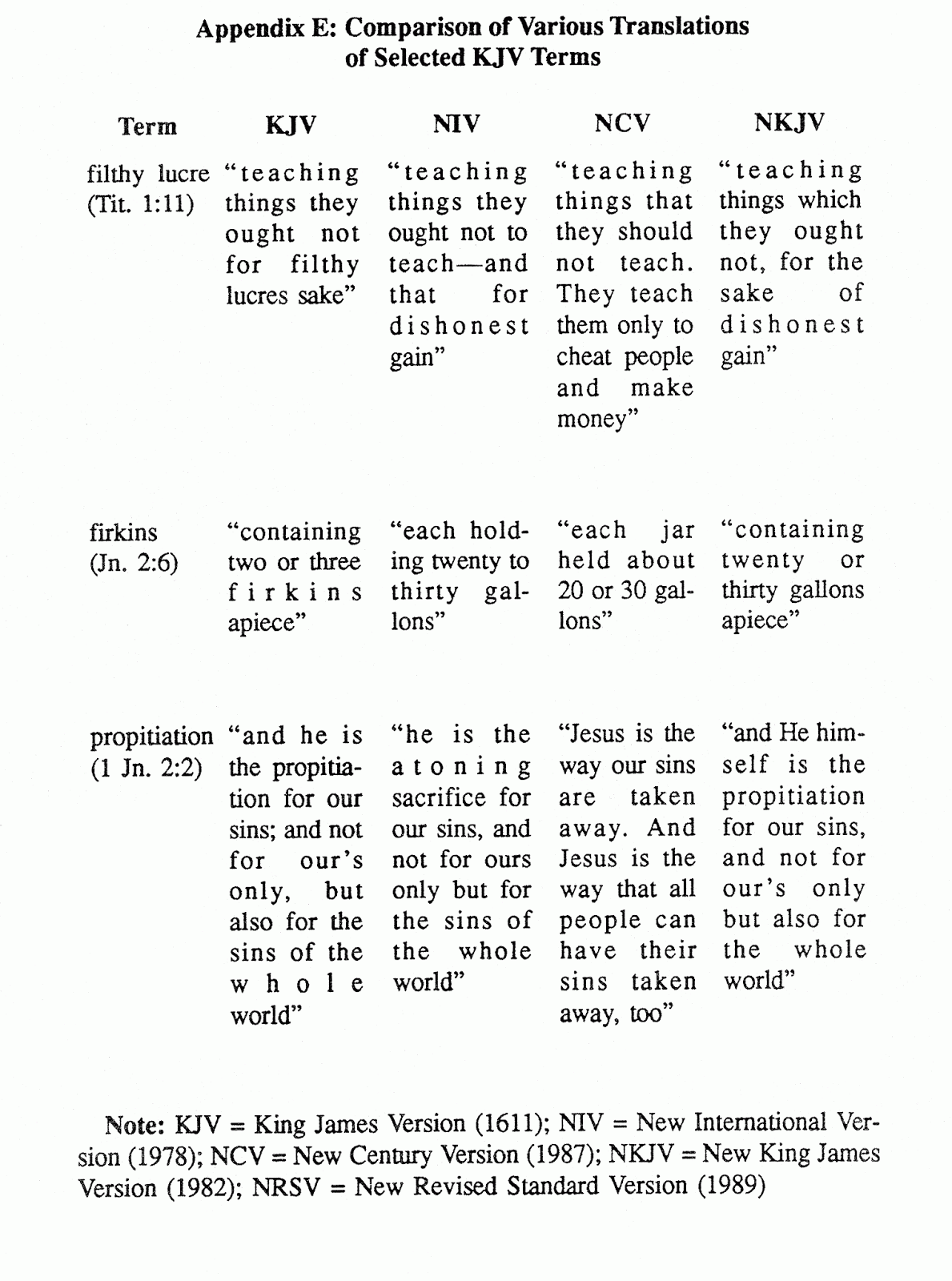
As may be seen in the "Comparison of various translations of selected KJV terms" in Appendix E, some of the other translations make it much clearer, easier to understand. Wisdom requires that we consider some alternatives to the KJV.
All of these examples suggest that the KJV may present many comprehension problems for twentieth century readers. As has been noted historically, when language has changed, making it difficult for the common man to be able to read it with relative ease new translations have been made. It is suggested therefore that a new translation is needed. But the big issue is what translation. As may be noted in Appendix F, there are numerous English translations available. From among all of these translations, how does one select one or more that may be safely used for Bible study?29 To assist in such a selection process, I have developed some guidelines for selecting a Bible translation [see Appendix H] It appears extremely important to keep in mind that doctrinal soundness is more important than readability, but this is not to take away from the importance of readability. May God help us in this crucially important endeavor.
*** IN THE PROCESS OF LOADING THESE APPENDIXES AT PRESENT --- SHOULD BE DONE THIS WEEK ****
Appendis A: Timeline --- Language Change, Bible Translations, and the Common Man
Appendix B:The Lord's Prayer in Historic English Versions
Appendix D: Potential Sources of Reading Problems Due to 379 Years of Language Change
Appendix E: Comparison of Various Translations of Selected KJV Terms
Appendix F: Chronological List of Bible Translations/Versions
Appendix G: Guidelines for Selcting Bible Versions
2. Jonathan Kozal in a speech delivered at Texas Tech University, 1989.
3. Smith, Nila Banton. American Reading Instruction. Newark, DL: International Reading Association. 1965, 1986. One chapter discusses the role of religion and the Bible in reading instruction in the United States.
4. See also Revelation 22:18-19; Galatians 1:6-9; 2 John 9; 1 Peter 1:21. 5. Opfell, Olga S. The King James Bible Translators. Jefferson, NC: McFarland & Company, 1982.
6. American Bible Society. A Ready-Reference History of the English Bible (1971 Revision). New York: American Bible Society, 1971.
7. Bruce, F. F. History of the Bible in English (Third edition). New York: Oxford University Press, 1978. Also, Lightfoot, Neil R. How We Got the Bible (Revised edition). Abilene, TX: A.C.U. Press, 1986. An excellent introductory work on this topic.
8. op cit.
9. op cit.
10. 1 Corinthians 14:9
11. Acts 2:8
12. italics mine, LOB.
13. "As also in all his epistles, speaking in them of these things; in which are some things hard to be understood, which they that are unlearned and unstable wrest, as they do also the other scriptures, unto their own destruction" (2 Peter 3:16).
14. 1 Corinthians 14:27-28
15. 1 Corinthians 14:5, 26
16. Preface to the KJV: "Translators to the Reader" in Opfell, Olga S. The King James Bible Translators. Jefferson, NC: McFarland & Company, 1982, p. 157.
17. op cit., p. 147.
18. In 1611 vulgar meant common or of the masses.
19. Opfel, op cit, p. 148.
20. “But the word of the Lord endureth for ever. And this is the word which by the gospel is preached unto you” (1 Peter 1:25).
21. Wycliffe Translation.
22. Webster's New Collegiate Dictionary, G. & C. Merriam Company, 1976, p. 1314.
23. Lightfoot, Neil R. How We Got the Bible (Revised edition). Abilene, TX: A.C.U. Press, 1986. An excellent introductory work on this topic.
24. American Bible Society. A Ready-Reference History of the English Bible. (1971 Revision). New York: American Bible Society, 1971, p. 38.
25. The reader is referred to an audiotape, "A Word in Your Ear" for what scholars believe to be the way the Lord's Prayer sounded between A.D. 1000 and A.D. 1300.
26. From Lewis, Jack P. The English Bible From KJV To NIV: A History and Evaluation, Grand Rapids, MI: Baker Book House, 1981, 1982, p. 55. [Young's or Strong's concordances may be used to locate verses in which these words are used.]
27. Burchfield, Robert W. The Compact Edition of the Oxford English Dictionary. Oxford University Press, 1971. The Oxford English Dictionary, First edition, together with the Supplements and the Secon edition (20 volumes) published in 1989, are outstanding sources of information regarding the meanings of English words during the various periods. This is an excellent reference for checking meanings of words as they were commonly used in 1611. It is expensive. Many, if not most public or university libraries have it. Vines Dictionary of New Testament Words.
28. Oxford English Dictionary provides the meanings of words in different periods of history.
29. In view of the current state of affairs, it appears wise to consult multiple versions. By making comparisons, and then using appropriate references, we will more likely arrive at God's intended message. Parallel Bibles, such as Comparative Study Bible (Zondervan), which uses the KJV as the base, are highly recommended.
Sunday, August 24, 2008
Table of Contents
*** PLEASE NOTE: IF YOU SEE AN ARTICLE LISTED THAT IS NOT POSTED YET --- THAT YOU WOULD LIKE POSTED PLEASE CONTACT ME AND I WILL DO SO ASAP, Dennis at BibleTruths@hotmail.com ***
“ ”Prove All Things" ** Don McCord
Journey Out or Time Terry Haze
The New Birth (John 3:3-5)** Joe Hisle
The New Age Movement Alan Bonifay
Sanitation and the Lord’s Supper Bruce Word
How Defined Are the Lines of Fellowship?Allen Bailey
Saving Our Children** Joe Norton
The Effect of Television on Children * James Orten
Drunkenness: A Bible Definition Ronald Courter
Fasting: “When,” Not “if”’** Don Pruitt
Old Testament Quotations George Battey
“This Cup Is the New Testament” Wayne Fussel
Imputed Righteousness Johnny Elmore
Islam Smith Bibens
Translations Used During the Restoration Richard Bunner
Translations: Should We Insist on the King James Version Only? G. Butler
Return to the Main Menu -- Home
Sanitation and the Lord’s Supper
I am going to go about the study in a little different way today than I had originally planned. I cannot possibly answer all of your questions, but I do hope to impart some information to you that may be helpful in dealing with the subject.
The focus of our study is going to be on sanitation in communion “in light of recent developments.” That, of course, primarily has reference to a disease called AIDS. Before we can understand the issue, we must be able to understand what it is we are dealing with. Fear exists even among Christians! This fear is not so much a fear of the disease itself, but the stigma attached to it!
“AIDS” stands for the Acquired Immune Deficiency Syndrome, a disease which is a sever breakdown of the body’s immune system. This disorder leaves the body vulnerable to a variety of unusual, life threatening illnesses. It is these diseases, not the AIDS virus itself, which can result in death. The common cold becomes a killer to the person with the AIDS virus. The most common illnesses found in people with the HIV virus are: PCP, a type of pneumonia, and KS a form of cancer; both, killers!
AIDS cases have been documented as early as 1977, although now we know that a similar disease was documented in 1951. And as far back as 1827, similar diseases have been known to exist (although people did not know what to call them.) Since 1977, the illness has been diagnosed around the world with increasing frequency. Scientists expect the AIDS epidemic to continue to spread. There is no known cure or vaccine for the disease (although one lady did say that Nature’s Sunshine herbs was a sure cure). Understanding how the virus is contracted, how it is spread, and how to prevent its transmission; are the only ways to slow the epidemic at this time.
I want to preface all my future statements with this one thing. The disease is the result of sin, and I refuse to use the word “gay” in this study. There is nothing “gay” about the sin of homosexuality, and the Bible specifically condemns this sin. I will not soft sell the sin, and I refuse to call it an alternative lifestyle! It is not. It is an abomination unto the Lord (Leveticus 18:22; 20:13; Deuteronomy 23:17)!
- Homosexuals, 64%
I.V. (intravenous) drug users, 18%
heterosexuals, 4% rising to 9% in 1991
Hemophiliacs 3%;
(and it is known that 93% of all aids victims are men).
Aids was initially identified as an epidemic in 1981 and was first seen in homosexual and bisexual men. Shortly thereafter, I.V. drug users began accounting for a high percentage of all AIDS cases in the U.S. Others who are at risk for developing AIDS are children born to parents who are infected with the virus, and people who have other blood disorders who must receive blood. (Just as a side note, of the cases that I am personally familiar with, the people have the HIV virus as a result of blood transfusions.)
- (1) through intimate sexual contact;
(2) through shared needles and syringes, a problem especially prevalent among I.V. drug users;
(3) through receiving blood or blood products that have been contaminated with the virus (but this risk has been greatly reduced by testing all blood donors for antibodies to the virus);
(4) through infected mothers passing the virus to their infants through the blood stream before and, or, at the time of birth.
The biggest question on our minds is, “Can this disease be transmitted by or through casual contact with a person who has it?” There are no reported cases of AIDS or HIV infection as the result of casual contact. Ordinary household and work-place contact with people infected with HIV is safe. (This is very important to our sanitation issue.) You CAN NOT become infected with HIV by sharing eating and drinking utensils or bathrooms. Just for your information, I was concerned about the cleanliness of public restrooms, elevators, busses and other public facilities long before I knew anything about AIDS.
Mosquitoes do not transmit the disease, and the common communion cup does not offer a suitable atmosphere for the HIV virus to live. Some tests have demonstrated that the active life of the HIV virus outside the carrier to be up to 15 hours, but these tests were conducted under laboratory conditions, and the virus was virtually kept alive by placing it in the right conditions for it to live.
Now some questions before we more on. “First, How do we respond to those among us who have the HIV virus, or full blown AIDS?” That is a legitimate question and I will at least begin the answer here and continue it in the discussion period. Above all, we must not make any assumptions as to how such individuals contracted the disease! We must then exercise our faith, for dealing with this problem is pre-eminently an exercise in faith. Titus 1:15 says, “to the pure, all things are pure.” If someone here had AIDS, or we converted someone with AIDS, we must act toward them in faith without wavering.
Second, “Is this a plague sent from God to destroy the people involved in the sin?” Some say yes, and point out Sodom and Gonorrah and what happened to them (Genesis 19:1-29). I believe the answer lies in Romans 1:27. It says, “Likewise also the men, leaving the natural use of the woman, burned in their lust for one another, men with men committing what is shameful and receiving in themselves the penalty of their error which is due.” The penalty is due them as a natural consequence of that sin! Romans 6:23 reads, “For the wages of sin is death, but the gift of God is eternal life through Jesus Christ our Lord.” They get what they deserve for their sinful conduct.
I have heard some say, “sure they sin, but that disease is just too much!” No, I am afraid that is not the case; they reap what they sow! I also want to say that the effects of this disease can certainly visit the children to the third and fourth generation (Exodus 20:5-6). The third and fourth generation may be totally innocent, but still feel the effects of the sins of their forefathers. This is not a plague sent to these people for the specific reason of punishing them, but it is the natural result of their sin. One thing that we must all remember, we will pay the consequences for our sins!
Homosexuality is wrong. It is a sin. But AIDS is not God’s direct curse on those who practice it. In God’s sight, there is no difference in the eternal consequences of different kinds of sin. In the Sermon on the Mount (Matthew 5:21-30), Jesus equates anger with murder and sexual lust with adultery. Sinful lifestyles have certain consequences.
Third, “What about innocent children who contract AIDS from parents who have the disease?” Answer: They are suffering the consequences of sin in the world. Not God’s wrath! The same holds true for those people who receive contaminated blood during transfusion.
The first thing that I would like to make clear is that this is not a discussion of the “cup” question. What we have been discussing may be more of an issue in future debates and personal studies, but this is not a discussion of the one cup per se.
Advocates of one communion vessel for the distribution of the fruit of the vine have not really had too much of a problem with the sanitation question as far as the safety of this scriptural method is concerned. That is until now!
In the beginning of the move to individual cups, it was generally stated that the practice was for health reasons. It was just healthier, some argued, to have each person use his or her own cup. The advocates of multiple containers for the distribution of the fruit of the vine felt that for all to drink out of one container would be unsanitary, and that this practice would promote the spread of disease from one to another. However, besides the fact that we are commanded to use one container, scientific proof exists that the risk of spreading (any) disease through drinking from the same container is nil.
I would like to read a quote out of “The Sacrament of the Lord’s Supper” by Thomas H. Warner;
“Until near the end of the nineteenth century the chalice, or cup, was used in the distribution of the wine at the Lord’s Supper. At that time more attention began to be paid to hygiene, and the use of the common cup began to be unpopular with communicants. Rev. J. 0. Thomas, who was both a minister and a physician, was the originator of the idea of the individual cups. From his medical practice he learned what he believed to be the uncleanliness and danger of the common cup and felt that the Lord’s Supper could be made more beautiful by the use of individual cups. His first patent was granted in march of 1894. The first service using individual cups was help in a little Putnam county church in Ohio.”
Thus the multi-cup idea was formed and brought into existence. However, it is an established fact that the church existed and prospered for 1900 years without individual cups, and there is no record of any of its members ever catching or dying from a disease as a result of using one cup as the Lord commanded. If the world stands that long, I am sure we will be safe in continuing to do what the Lord says for another 1900 years!
If you are truly worried today about the spread of disease through the communion cup, may I please give you some things to think about. I do not claim to be the expert, but from the standpoint of scientific studies that have been done, it is next to impossible to spread disease through the communion cup.
You may want to pick up a copy of “Sanitation in Communion” by brother Alton Bailey, [at “Strong Meat” site on this blog]. It has some studies listed that you can check out for yourself. One of these is a study conducted by Doctors William Burrows (associate professor of bacteriology) and Elizabeth Hemmons (instructor in the Walter 0. Zollar dental clinic). Their study shows that common communion cups do not spread disease. The only time these scientists were able to detect the transfer of any bacteria was when the first person left as much saliva as possible on the cup and the second drank immediately from the same spot. Then, they said, only .001% of the bacteria were transmitted from the first person to the second.
Notice, as much saliva as possible was left on the cup which is not the case in the communion service. And even then only .001 percent of the bacteria was passed on to the next individual. Monroe, head of the Colorado AIDS Research Project told me, “You cannot get AIDS off the Communion cup!”
The Head of the Center for Disease Control in Atlanta, Georgia, stated that to have even the slightest possibility of contracting the HIV virus from saliva, a person would literally have to drink buckets. Casual contact does not spread the disease.
The Surgeon General’s Report on AIDS states that one “cannot be transmitted from trace saliva on common communion cup.”
The Minnesota Department of Health, in responding to an Episcopal Bisphop’s question on AIDS, said, “In our opinion, the communion cup is safe.”
A Group called “Living Hope” in Seattle, Washington offers studies on the common communion cup. All say transmission of disease is not going to occur during a normal communion service.
These and many more furnish scientific proof that we should not worry about the transmission of this disease. As a matter of fact, in the case of the AIDS carrier, They are in greater danger than we are. They stand a greater chance of getting a life threatening disease from us than we do of getting AIDS from them. We stand a better chance of getting sick as a result of the air we are breathing than from catching AIDS from the communion cup.
Finally, Dr. G. A. Trott, a preacher, editor, and Medical Practitioner; in an article in the Apostolic Way dated September 1, 1913 said,
“I am willing to stake my professional reputation on the assertion that cultures made from the individual cup, made by a competent biologist, will reveal as many deadly germs as those made from the common cup. Give us the proof of the contention of the deadly danger of the common drinking cup before asking us to ignore the example set by our Lord and Apostles.”
My friends, I feel just like one person who said, “I am more afraid to disobey the Lord than I am of a few germs.”
I leave you with this thought. 1 Corinthians 11:27 reads, “Wherefore whosoever shall eat this bread, and drink this cup of the Lord, unworthily, shall be guilty of the body and blood of the Lord.” This is one passage of Scripture that needs to be used and thought about a lot. Verse 28 talks about how we are to examine ourselves as we eat the bread and drink the fruit of the vine from the cup. One aspect of examining ourselves is to see to it that we do not partake of the loaf or the cup of blessing in an unworthy manner, or as Strong’s says, irreverently!
If our minds are on the possibility of catching some disease while we are partaking of the cup of blessing, then we are not partaking in a worthy manner. As a matter of fact, I would have to examine my faith if I considered anything else but what I was doing! Remember Romans 14:23, “Whatsoever is not faith is sin”!
5875 Urban St., Arvada, CO 80004
Wednesday, August 20, 2008
Saving Our Children
Preacher Study Notes 1990 br /> last updated 18 August 2008X
We have the gospel. Why, then, are many children of Christian parents not saved? Why do our children not know the “Faith of Our Fathers” and realize the “Joy of Our Salvation?”
Throughout my quest for answers to these questions, I have had to ask myself constantly: What is this study?
- ·
Is it just a study of strict scriptural interpretation?
· Is it a study of parenting?
· Is it a study of behavior and behavior modification?
· Is it a study of discipline in the home?
· Is it a study of children obeying their parents in the Lord?
What is the study and what is its purpose? While the study includes all of the above topics, it is really about a somewhat different matter.
It is a study about souls — human beings — who have the decided advantage of learning the truth as a child, if we are only able to communicate it to them. It is a study about salvation. The question is: How can we save our children?
Even in nailing down the topic, I found frustration. There is a massive amount of literature on the market; and throughout that literature, all of the related topics listed above just flow together without distinction. The material was so vast that it was difficult to manage.
So I may not answer you questions today. I may not meet your expectations or your needs as I pass along information to you.
This is my approach to this study: I am passing along this material to gospel preachers who are parents, but also who have many searching, hurting parents needing help and needing answers. Am I qualified to do this? Certainly not. Are you?
Who sitting in this audience this afternoon basks in the floodlight of parental success? Not very many. Do we then throw up our hands and say no one can teach me because no one is qualified? That is not very practical or even very intelligent. Today we study and we learn together. And through that process we grow. We do better tomorrow than we did yesterday. We help others — yes, we pause to try to help others benefit from what we have learned through our own mistakes and failures. In some families, all children have been saved. In others, none have been. And, in even others, some have and some have not.
Why?
We do not have an answer to that question because what has worked in one family has not worked in another, even though both sets of parents have thought they were doing the very best in training their children in the Lord.
This one thing we do know: We cannot force our children to be saved. It will not work. We must set up conditions that hopefully will lead our children toward salvation, but we cannot force them. What can we do? First, we can turn to the Scriptures.
Please read: Deuteronomy 6:6-7 and 11:18-21.
In Deuteronomy 6, “to teach” means “to inculcate,” meaning train intensively God’s standards into the child by the use of repetition. It is to be consistent and to be given at every opportunity.
In Deuteronomy 11, “teach” means to “teach by intensive drill.” The same word is used to describe the training of a soldier for war. “The derivative of this word is the word for goad, a sharp stick used for prodding cattle or oxen. A goad was sharp enough to go through the animal’s tough hide and get his attention” (Fugate, p. 55).
Proverbs 22:6 says, “Train up a child in the way he should go and when he is old he will not depart. . .“ The Hebrew word translated here “train” is translated “dedicate” in every other place it is used. To dedicate means “to renew, inaugurate, or initiate” (Fugate, p. 52).
Parents are to initiate their children in a certain path — not just a one-time initiation or dedication, but an extended training process.
The result of this training is for this new way to become the child’s own way of life. When this transpires, the child will not leave the path even as he is growing older and becomes an adult (Fugate, p. 52).
The ancient root of this Hebrew word meant “to make narrow” and even “to strangle.” “In other words, parents are to restrict the path their children may follow” (Fugate, p. 52). They are not to wait until the child is almost grown and then try to exert some influence but to give this direction while he is still in the child state of development — under 13. Parents exert this control while the child is very young but gradually let go so that he can direct his own path by the time he is grown. “A child who has been trained to be obedient to his parents will respect their position of authority and be prepared to accept their instructions” (Fugate, p. 52).
Training of children is necessary, both restraining them from sin and teaching them the right path to follow. Children would prefer following their own ways rather than being led in the right way to go many times, but they cannot be left to their own whims and devices. Proverbs 29:15 teaches, "a child left to himself brings his mother to shame.” The Homiletic Commentary says that a parent should hedge in the pathway of a child.
“If the parent does not set a hedge about his son’s path, he is only making it certain that he will encounter thorns and snares further on in life . . . The child that is accustomed to bend its will to the will of a good father will not find it so hard to yield obedience to the will of God as he who has no such training” (Proverbs, p. 638).
The Homiletic Commentary does not teach that the promise of Proverbs 22:6 has universal application or guarantee; and many other commentators, such as Matthew Henry and Adam Clarke, agree. Henry calls it cruel neglect to let a child have its own way with no restraint and says this passage means, “evangelize them; initiate, keep them under discipline. Train them as soldiers, who are taught to handle their arms, keep rank and observe the word of command” (Henry, vol. 3, p. 917). These commentators believe the application is given as more of a general rule than an absolute guarantee, and they cite Solomon and the sons of Samuel as examples of their reasoning. Solomon, son of David, was trained by a man who was on a personal level with God; yet he went astray, although he is supposed to have come back before death. Another of David’s sons, Absalom, was reared in the same household, but he grew up to martial an army against his father. Samuel surely gave his sons adequate training in things spiritual, yet they were evil (see 1 Samuel 8:1-5). “Yet we cannot suppose that Samuel, who had seen in Eli’s family the miserable fruits of non-restraint, had neglected to train his sons” (Homiletic Commentary, Samuel, p. 639)
Adam Clarke says about this passage:
“Initiate the child at the opening of his path .. . When he comes to the opening of the way of life, being able to walk alone, and to choose; stop at this entrance, and begin a series of instructions, how he is to conduct himself in every step he takes. Show him the duties, the dangers, and the blessings, of the path; give him directions how to perform the duties, how to escape the dangers, and how to secure the blessings, which all lie before him. Fix these on him by daily inculcation, till their impression is become indelible; then lead him to practice by slow and almost imperceptible degrees, till each indelible impression becomes a strongly radiated habit” (p. 546).
And Clarke stresses the necessity of incessantly begging God for help. We cannot overemphasize the power of prayer.
Please read: Ephesians 6:1-4 and Colossians 3:21.
Vine says the word “right” means “that which is in accordance with rule.” Ephesians 6:2 is a repetition of the teaching in Exodus 20:12.
The verse in this passage in Ephesians that directly relates to our topic is verse 4. “Provoke” means “to stir to anger.” The word “nurture” means “chastening, denoting the training of a child, including instruction; hence discipline, correction, chastening —suggests the Christian discipline that regulates character.” (Vine, p. 183)
“Admonition” means “to correct by discipline or to train by act” (Vine, p. 31).
The difference between “admonition” and “teach” seems to be that whereas the former has mainly in view the things that are wrong and call for warning, the latter has to do chiefly with the importation of positive truth (Vine, p. 31).
The young evangelist Timothy is an example of one who had been trained in the Lord (cf. 2 Timothy 1:5). 2 Timothy 3:15 reads, “And that from a child thou hast known the holy Scriptures, which are able to make thee wise unto salvation through faith which is in Christ Jesus.”
Jesus Himself is another example of a child obeying his parents (cf. Luke 2:40-52). Jesus was twelve years old at the time. Older women are to teach younger women how to accomplish these goals (Titus 2:3-5).
Not Working Anymore?
What Are Our Modern Problems?
First of all, let us establish that we cannot prove that they are not working. We have no research or statistics to prove that we are saving fewer children or a fewer percentage of children, than, say, thirty years ago. If our forefathers had enjoyed the overwhelming success that we think they did, the church in America would be much, much larger than it now is.
But, what are the modern problems that cause such a spiritual dilemma for many of our children? Why do they come into some homes and say, “I don’t believe those things anymore,” or “You can’t make me believe what you believe,” or other similar statements?
- 1. The concepts of good and evil have been blended in our world. This problem raises its ugly head in just about every problem we deal with today: sex, drugs, alcohol, lying, stealing, etc.
It is easy for those opposed to drug abuse to advocate: “Just Say No." The problem is people today have trouble deciding where the good stops and the bad begins. “Just Say No” is disarmingly simple advice. Yet, if it were uniformly practiced today, think what it could do not only for drug use but to all human temptations. “Just Say No” could also be applied to many human problems, including hatred, prejudice, crime, greed, corruption pornography, sexual diseases, alcoholism, eating disorders, the destruction of the environment — all of these could be handled effectively if “Just Say No” would work every time.
2. Television. Brother James Orten will discuss the impact of television on our society and our children in his presentation tonight. Let us just say that research proves conclusively that too much television or the wrong kind of programs can have negative effects on our children.
3. The music our young people listen to. Beyond a doubt, music has become an important part of life, and it was a source of unity in families for centuries. But, today it often divides us. In times past, families could sing together and listen to music together. But today what are we likely to hear in the home about music? “Turn that noise off.”
Just as it is with television, there is no doubt that music influences us. It affects our moods and emotions, and through it we express whether we are happy or sad. Some researchers tell us that music even affects babies in the womb.
A. P. Merriam expressed in his book, The Anthropology of Music, that “through the ages, music has always accompanied every deeply emotional human experience, from mourning to celebration. People have long used music to convey what is inexpressible in words, and all music serves the function of stimulating some kind of emotion” (Plain Truth, October 1989, p. 12).
Different types of songs express different emotions. Songs about nationalism stir love for a person’s country. Love songs help us pour out emotional feelings for another person. Spiritual songs and hymns express our praise to God.
Dr. Joseph Stuessy, professor of music at the University of Texas at San Antonio and author of The Heavy Metal User’s Manual, holds that music does affect behavior. “Any kind of music affects our moods, emotions, attitudes, and our resultant behavior. Music has both psychological and physiological effects on people. That’s why we have choirs and organs in churches and synagogues, bands at football games, Music in business and doctors’ offices, military marches, background music for movies and television programs, Jazzercise where legions of people are motivated to move by rock music, and most important, commercial jingles” (Gore, p. 37).
In past generations, church families always used music as a source of entertainment and a source of unity. It appears that we have lost that source of spiritual unity in many or most church families. Few things in society have contributed to the development or the widening of the generation gap more than modem music. Parents are alarmed by such music as heavy metal, punk-rock, and rap music of the modern generation; and well they might be. Besides the obvious problems of the direct immoral, irreverent, sadistic, and rebellion-stimulating messages in much modern music, there is also the problem of subliminal messages conveyed through the process of back masking.
A real concern of all caring parents and certainly all Christian parents today is expressed in the question, “What kind of music should children listen to?” There is no easy answer to that question. We do know that:
- a. Whatever is popular they will want to listen to.
b. There should be a balance as to the type of music allowed.
c. Saying “No” without discussion will cause resentment in some.
d. To some kinds of music (such as the types mentioned above), we must emphatically say, “No.”
Some singing groups promote not only sex but also violence and sadistic behavior on their album covers as well as in the words to the music. Some covers have explicit scenes blatantly pictured on them. Words to some songs are so grossly immoral and perverted that they have aroused the attention of even many parents of the world not connected with religion. Some of the activities of these parents as well as helpful information about what is really in many modern songs are given in a book called Raising PG Kids in an X Rated Society by Tipper Gore. Every parent should read this book, but you should know that it contains the most explicit language that you can imagine. This book contains modem song lyrics so explicit that I cannot read them before this audience. But these words are what many young people of today are listening to many hours a day.
“Plato wrote that music had the power to shape society. Today, those who orchestrate the successful commercial jingle can certainly control social and commercial behavior. Advertisers would not spend billions annually if music and other messages were not persuasive. According to Dr. Stuessy, music aids retention of verbal messages; we are more likely to remember a message if it comes to us in a musical context,” (Gore, p. 37).
If parents of the world are concerned enough to form a national organization to try to deal with the problem, surely we as Christian parents should realize the gravity of the situation and be very much concerned about what our children are listening to because it does make a difference what they listen to.
Music is like television. There is no doubt about the influence it has over anyone who listens—especially young minds still in the impressionable stages. It is bound to be one of the reasons some of our young are being led astray, rebelling against all that is right and good and desiring that which is evil.
4. Humanism has infiltrated our society. “It is safe to say that all public schools in America do indeed teach, to at least some degree, the philosophy” (Newsletter, p. 1).
The philosophy of humanism is credited as being a primary factor in the deterioration of Christian homes. This philosophy has crept into our public schools, television, radio, music, and other areas of our society. Children who have been taught the Bible by faithful Christian parents are coming home from school, in some instances, and announcing they do not believe the Bible any more. Why? Humanism is the answer in many cases.
... humanism has permeated, if not saturated every facet of our culture, including all but very conservative churches, and has become the working philosophy of all our professions and many of our businesses. Its scope is international, being accepted not only throughout the Western World, but also influential upon Third World nations (Waggoner, p. 6).
Humanism is a godless religion which makes man the only standard by which all things are to be judged. Modern humanism is not to be confused with what we often call humanness or humanitarianism. It is rather a militant philosophy which believes that man is but the evolutionary product of nature. It denies the existence of God, the authority of scripture, life after death, sin, heaven, hell, etc. While not a new philosophy, it was somewhat dormant until the advent and acceptance of Darwin’s theory of organic evolution in the Western World. Its beliefs are documented by the Humanist Manifesto I and II, published in 1933 and 1973, respectively. Humanism is the primary philosophy behind such modern social and political issues as the Equal Rights Amendment, the Gay Rights movement, abortion, and the right to suicide (Waggoner, p. 7).
Components of our society are now operating on humanistic rather than on Christian principles. That is not to say that most Americans are humanists, but many are. And it is no wonder since John Dewey introduced the ideas of humanism into our public school system many years ago. In one middle school, a teacher told her students that they should try homosexuality and heterosexuality to see which one they were meant to be. In one first grade classroom, the teacher played “Lifeboat Strategy” with her class. One student came home telling his mother there were two people in a boat: Jesus Christ and the mother. He bragged that he had thrown his mother out of the boat. These are the kinds of problems and decision-making situations used in the Quest program around the country. Underlying the concept of the Quest program is humanism.
5. Satanism. In some parts of the country, Satanism is becoming a big problem and is being promoted even by people in positions of influence. A police officer in our community warned parents to know with whom their children were running, where they were going, and what they were doing at all times because of this problem. Churches of Satan have even sprung up in some areas. Cults are spreading and have a real possibility of influencing our children.
6. Influence of Public Schools. In view of the topics we have discussed already, I think we can see that outside influences are bombarding our homes. The public schools are no exception. Just because something happens at school does not mean it is okay. We need to know what our children are doing at school and what they are being taught.
Parents must understand that it is not just hard-core rebellion against us or God that is the only problem. Some are subtly influenced and begin drifting long before they actually leave.
What Are Some Principles that Have Worked?
- 1. Teach them the gospel. Our children are just as subject to the Great Commission as any others in the world. It is still true for them that “He that believeth and is baptized shall be saved; but he that believeth not shall be damned” (Mark 16:16).
We need to restore the family altar and home Bible study if we expect our children to respond to the gospel call. What they are taught in the public assembly of the church is not enough. They need parents in the home teaching them the gospel plan of salvation, too. Family nights create memory pockets for children; and even if they stray for a while, they will remember and, hopefully, return to the beliefs that have been instilled into them in the home. Family nights need not be just Bible reading and study, although these should be at the center. A variety of activities can be planned that will strengthen the family unit and bring it closer together, forming a bond that will carry with children as they go into their adult lives.
In the home and in the congregation, more individual Christians should design activities that will keep young people more actively involved in spiritual development. Recreational activities planned by individuals have their place, but we have too long neglected activities that will enhance spiritual growth.
2. Instill within them a love for the truth. Parents can let their children know that they are firmly grounded in the truth and that they believe in it. Parents should communicate their own love for the truth and their own conviction that they believe in the Bible and in its authority over their lives.
By example, parents can let their children know they are enjoying their Christianity and that it is real to them.
3. Teach values. One of the best ways to teach values is to allow young people the experience of deciding between right and wrong while they are still young. In other words, avoid overprotecting them. Overprotected children many times find themselves at a loss when they are finally confronted with the realities of life. Guide a pre-teen in little things regarding study habits, visiting with a friend, or the amount of time spent watching television. And, hopefully, by age 16, the teen will be ready to make reasonable judgments about such things and others more important for themselves.
The other side of overprotection is lack of guidelines. Many young people today are growing up with few restrictions. Many parents today simply do not know what their teenagers are doing. Not wanting to overprotect a child should not be a cop-out for parents who do not really want to deal with problems. Some parents must reason within themselves that if they do not know what their children are doing, they do not have to deal with the resultant problems. Just because they do not know what they are doing does not mean there are no problems. Teenagers sometimes try to inhibit their parents by demanding their rights to privacy. Parents have a right to know what their teenagers are doing as long as they are under their supervision.
Parents must first accept the fact that teenagers are going to be tempted. They do have feelings, and these will surface as they grow older. If we have not instilled, at early impressionable ages, the difference between right and wrong and the consequences of wrong, we will have a difficult time in the later growing up years. And even if we have instilled these values, we still may go through some rough times.
Parents should be instilling or internalizing God’s values into their children instead of imposing values upon them. “Imposing these values is a Band-Aid over a wound that will grow wider every year” (Lucas, p. 148). Jehoiada’s family learned that sacrificing for a child is not enough. “Love is not enough. Kindness is not enough. Either the values are a part of the child, or they are nothing and will disappear when you disappear” (Lucas, p. 148).
Some are able to produce children that look good on the surface, and there appear to be no problems. The values they have imposed last their children perhaps through high school or even college, but usually they do not last a lifetime.
“Like Pavlovian dogs that respond to the stimulus of the mastermind, your children can be behavior modified and assertively disciplined until their instant and mindless responses impress your friends and family and woo converts to the idea of parental despotism,” (Lucas, p. 148).
But the question is: Will those values disappear with you? It takes more time to internalize than to impose values. “Internalizing is a process, while imposing is simply an act” (Lucas, p. 149). One man taught his son about integrity by teaching him the Scriptures about a man of integrity. He discussed and observed the consequences of lying and the benefits of telling the truth. Then he asked him questions regularly about which kind of person he wanted to be. It was an ongoing process that took time.
4. Let home be a haven. Make home a comfort zone. Give your children pleasant and relaxed time at home. Be there to listen to a child when he needs to talk and to help him when he needs help. If a child is having frustrations at school because he is different, give all of the time he needs to work through those frustrations, all the while letting him feel your caring and your support.
5. Give unconditional love. The Bible is replete with teaching emphasizing that true love is unconditional. We are taught to love the sinner but hate the sin. Jesus dealt firmly with the Scribes and Pharisees; but all the while He prepared to die for them as well as for the rest of the world. As parents we cannot condone the sins of our children and expect to save them. But, on the other hand, we must let them know we love them and care about them and their salvation.
6. Be consistent. This principle is one of the most important and the most difficult.
7. Communicate. Children need someone to talk with even while they are still young. As teenagers they will find someone to talk with, of that we can be assured. If we have developed lines of communication while they are young, they will be much more likely to come to us with their problems in the later growing up years.
Create special times for communication — private communication. Take time away together. Take a child out to eat, take him fishing, take her shopping, engage in some things that will give you time with that child.
8. Pray. Most of all, pray. “Pray without ceasing” (1 Thessalonians 5:17) the great Apostle Paul so wisely advised. The most important tool we have in rearing our children in the Lord is prayer. We can use all other means at our disposal and not save our children without the Lord’s blessing. We need the Lord in the awesome task, and we must let Him know that we realize that need.
The power of prayer has made the difference in the saving of more children than we will ever know. The forces we are fighting are powerful, so we need God’s power with us in combating those forces. Paul said, “We wrestle not against flesh and blood, but against principalities, against powers, against the rulers of the darkness of this world” (Ephesians 6:12) God has promised to hear and answer our prayers, and we need that assurance as we attempt to bring children up in the nurture and admonition of the Lord.
There is no formula for us to communicate to church members that will work in every case. Each situation is different. Each child. Each parent. Each family. But with God’s help, we can be successful in saving our children.
Clarke, Adam. Commentary on the Whole Bible. One Volume Edition. Michigan:Baker Book House, 1967.
______ Newsletter. “Do All Public Schools Teach Humanism?” Building
Better Christian Homes. (September-October 1989), p. 1.
Fugate, J. Richard. What the Bible Says about Child Training. Texas:Aletheia Publications, 1980.
Gore, Tipper. Raising PG Kids in an X-rated Society. New York:Bantam Books, 1987.
Harris, W., et.al. A Homiletic Commentary on the Old Testament. New York:Funk and Wagnall’s Company, n.d.
Henry, Matthew. Commentary on the Whole Bible. Six volumes. Virginia: Macdonald Publishing Company, n.d.
Lucas, J. R. Parenting of Champions. Tennessee: Wolgemuth and Hyatt Publishers, Inc., 1989.
______ “Tune Up Your Musical Taste.” Plain Truth Magazine. (October
1989), p. 12.
Vine, W. E. An Expository Dictionary of New Testament Words. New Jersey:Fleming H. Revell Company, 1966.
Waggoner, Robert L. What’s Happening to Our Christian Homes?
Subscribe to:
Posts (Atom)
